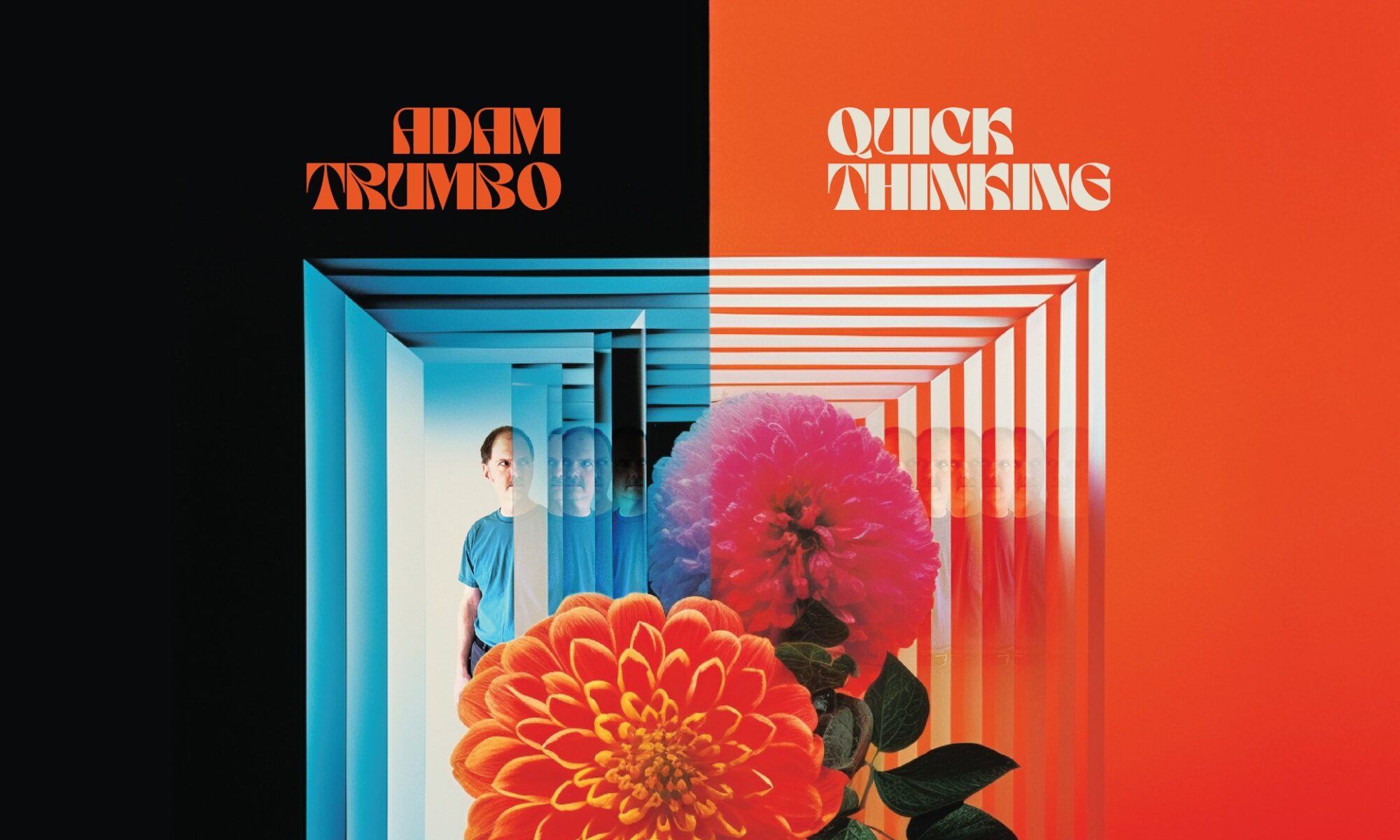
Quick Thinking
Adam Trumbo | 2025 | FST251
—
There’s a moment near the middle of “Palm of My Hand,” the second track on Adam Trumbo’s fifth solo album, where the narrator simply decides to go for a walk. “Notified and distracted, before I’m out of bed / Busy driving me crazy, think I’ll go for a walk instead.” It’s such a small, human, almost mundane resolution — and yet in the context of the song, and of the album as a whole, it lands as something close to heroic. When asked whether the album offers solutions or just observations, Trumbo responded with characteristic wit: “The character in that song found an apparent solution for what that character was feeling. Did that character actually go on the walk? I’d like to follow up and find out. Sounded like a good idea, though, didn’t it?” That’s Adam Trumbo in a nutshell — the ability to locate genuine wisdom and courage in ordinary moments, delivered with a wink that keeps the sentiment from curdling into sentimentality.
Quick Thinking is Trumbo’s most fully realized album — a 10-song, 32-minute ride that announces its intentions immediately and never wavers. Recorded with a small, trusted circle of collaborators — drummer Shawn Pantaliono anchoring every track, with lead guitar contributions from Brad Gordon and Kevin O’Dea, and brother Geoff Trumbo on bass for two key songs — the album tackles mental health, the distortion of reality, and the creeping encroachment of technology on human consciousness. Heady themes, handled with extraordinary lightness of touch. The album’s title is itself a provocation: AI is obviously up to the challenge of increasingly quick thinking, but can we keep up and stay ahead enough to maintain control and still promote a human-friendly society where people have relationships, goals, and genuine lives? Quick Thinking doesn’t answer that question. It sits with it, turns it over, and refuses to look away.
The first thing most listeners will notice — and the album’s most audacious creative decision — is that Quick Thinking often sounds like a record drenched in synthesizers. The shimmery new wave atmosphere, the pulsing textures, the cool electronic shimmer running beneath the surface — it all suggests keyboards everywhere. There are none. Every sound on this record comes from guitars, bass, drums, and vocals. This wasn’t an accident or a limitation. The concept crystallized during the very first recording session, when Trumbo finally found a use for a Mel9 guitar pedal he had owned for years. Shortly after, he acquired a Mono Synth pedal, and between the two, a whole sonic world opened up. “The idea came as a flash,” he recalls, “and the execution of the idea was really smooth. Now I can’t imagine it going in a different direction.” Crucially, by using guitars to simulate synthesizer tones, Trumbo can bend strings and deploy his tremolo arm to reach pitches that don’t exist on a regular keyboard — those blue, in-between notes that fall in the cracks of equal temperament. “I like sounds that get squirrely,” he says simply. The result is a record that proves its own thesis before you’ve finished the first song: you hear synthesizers that aren’t there. Your perception of reality is already being manipulated. Welcome to the album.
The approach also carries an important practical philosophy. “These days, with unlimited tracks and home studio spaces, if you don’t have a clear direction and the ability to make decisions, you can end up with a project that never gets completed.” Constraints, embraced fully, become creative engines. Quick Thinking is proof.
—
Side One
The opening track, “Make Room for the Bloom,” serves as both invitation and manifesto. The song begins with quick stabs of guitar alternating between speakers — establishing an immediate sense of alert, twitchy energy. Performed by just Trumbo and Pantaliono, the song addresses someone who has been hiding — from their own creativity, their own truth, their own bloom. “Aren’t you tired of hiding away? / Make room for the bloom, it should be on display.” It’s an encouraging hand extended to the listener before the album has properly begun.
“Palm of My Hand” introduces the full band and immediately deepens the album’s thematic concerns. Geoff Trumbo’s bass lays down a heavy, steady groove. Brad Gordon’s brief appearance is a delicate, articulate solo that sings rather than shouts, finding the emotional center of the song without overwhelming it. The lyrics are the album’s most direct engagement with information overload: “Ringing bells and following, man, you should see me scroll / Wasting time and energy, these are not my goals (but I’m on a roll).” That parenthetical aside is classic Trumbo — a flash of rueful self-awareness that cuts through potential self-pity with a well-timed wink. Throughout this track and “Swing for the Fences,” Trumbo’s tremolo arm work gives the songs an unsteady, variable feeling that mirrors the disorientation of digital life with uncanny precision.
“Predictions” is the album’s most musically expansive track and one of its lyrical high points. When asked what headspace he was in while writing it, Trumbo offered one of the interview’s most startling and illuminating answers: “It was channeling Emily Dickinson reacting to an AI world.” That framing clarifies everything. Dickinson’s compressed, slant-rhymed, oblique approach to enormous subjects — consciousness, perception, eternity — translated into the present moment of algorithmic reality. Gordon returns on lead guitar, this time channeling something considerably more ferocious, a performance requiring zero digital edits, absolutely live. “He absolutely killed it, and it was an amazing thing to witness in the studio.” The song’s central lyrical achievement is its productive ambiguity: “Your predictions are coming true / Now the world will see what you knew.” Is this vindication or paranoia? The music doesn’t resolve the question. Neither does the world.
“Swing for the Fences” is where the album’s sonic concept takes its most dramatic turn. Kevin O’Dea contributes chiming guitar licks through the first two-thirds, giving the song a bright, open quality before unleashing a shoegazey wall of sound at the conclusion. Musically, it enacts its own thesis: you stop calculating, you stop protecting yourself, and you just swing. “There’s no sense expecting failure in advance” is the kind of line that sounds almost too simple until you sit with it and realize how much courage that particular simplicity requires.
“It’s Your Time Either Way” closes side one on the album’s most “synthesized” note. A seemingly guitarless arrangement performed by just Trumbo and Pantaliono, it’s a song about creative mentorship that Trumbo describes as “a reminder to all of us (myself included) that time is marching on, and we either sit on the sidelines, or we get in the game and live a little bit. You can scroll or you can do something.” The line “I know what you wrote, and I believe in your curious phrases” lands with particular weight — a direct acknowledgment of creative work that feels genuinely seen. “It’s all about tone until your speaker cone is blown” addresses the digital age’s specific anxieties while simultaneously reaching back to something timeless. It’s the album’s most new wave sounding track, and Pantaliono’s thirty-plus years of partnership with Trumbo is audible in every measured beat — a musician who, in Trumbo’s words, “can read my mind and anticipate my songs before I’ve even finished writing them.”
—
Side Two
Side two begins with a crash and a thud — literally. “More Than One Way” opens with a version of itself playing on Trumbo’s old Tascam 4-track, slowed down with a quick twist of the Pitch Control knob until it crashes into nothing. Then the song starts again, now in Jason Groves’s mix from Sneak Attack studio. It’s a formal gesture that is also a thematic one: the album about perception and reality interrupts itself, collapses its own previous version, and starts over. Side two begins as a small act of creative destruction before becoming the album’s most overtly communal and resistant track. “We’re sick and tired of them pushing us around” is Trumbo at his most pointed, and Brad Gordon’s guitar work here is his most versatile on the record — edgy punk rhythm throughout, building to a solo that serves the song’s argument rather than interrupting it. “No trace at all on the candy man’s hands” is the album’s most politically charged image, invisible systemic power leaving no fingerprints. “More than one way, more than one way to be” becomes an assertion of pluralism against any force — technological, political, cultural — that insists on a single permissible reality. All the while, Pantaliono’s drums are spectacular.
“My Mind Plays Tricks” is the album’s most interior and vulnerable moment — a song about the unreliability of perception from the inside, when the distortion isn’t coming from screens or algorithms but from the mind itself. “I start to hear you, but the sound has risen above / Your words may reach me, but the messages are stuck.” Mental health territory handled with complete honesty and zero melodrama. “I know my mind plays tricks on me” is sung not as complaint but as hard-won acknowledgment — the kind of self-knowledge that is its own form of progress.
“Cascading Images” is the album’s most formally elegant track — a song whose chord progression literally cascades, the musical structure enacting the lyrical content in real time. One of the two songs recorded in the very first session that sparked the album’s entire concept, it has the quality of a seed from which everything else grew. “I had a vision an hour ago in cascading images” — the brevity of the lyric matches the flickering, fragmentary quality of the visions themselves. “I see it all — can you not see it at all?” The gap between what one person perceives and what another can access is the album’s central philosophical concern, stated here with maximum economy. It is a perfect diamond of a song that does everything it needs to do and stops.
“Speaking Through the Breeze” opens with honest disorientation before arriving at one of the album’s most beautiful images: “We’re just speaking through the breeze now, talking with the windows open.” Connection as the antidote to confusion. Human contact, even imperfect and uncertain, as the thing that cuts through the noise. Kevin O’Dea joins on backing vocals alongside Pantaliono, adding strength in numbers to a song that earns its emotional openness completely. “I don’t have to be like you / And you don’t have to be like me / There’s more than one way, more than one way to be” — the album’s central assertion of pluralism returns, this time gentler, more intimate, less defiant and more simply true. It’s the perfect setup for what comes next.
—
The Closer
“Call Your Bluff” is the album’s longest and most fully developed track, running 5 minutes and 39 seconds — an eternity by Quick Thinking‘s compressed standards, and worth every second. Trumbo describes it as “a bit of a beast” and “the inevitable end,” a track with “some finality, as well as some hard-earned wisdom.” The slowly evolving, building arrangement introduces different sounds and textures as Jenny’s story develops — a musical architecture that mirrors Jenny’s own arc from exhaustion to strength.
Jenny’s journey across the song is one of the more emotionally complete character portraits in recent memory. She begins with “hands disappearing up into her sleeves” — a devastating physical detail that tells you everything about someone making themselves small. She steels herself. She leans into her own creative voice. She arrives at full power. “How could a room of ghosts take up so much space?” remains the album’s single most devastating image — the weight of unacknowledged history, unspoken things, absent presences filling a space more completely than actual people ever could.
And then, after Jenny has been through everything — after the emotional weight of nine songs has accumulated, after “words are not enough” and she finally calls the bluff and the silent one speaks — the song ends on this:
*867-5309 Valentine.*
Tommy Tutone’s Jenny, the girl whose number was written on a bathroom wall, the girl who became a pop culture myth, the girl who exists in a kind of shared cultural hallucination — she’s been here all along. In the context of an album about AI, perception, and the confusion of reality, invoking a song that is itself about a number on a wall, about anonymous connection, about the blurring of public and private, is a genuine act of compositional intelligence. And after all the weight and history and ghosts filling rooms, the album ends with a grin. Not despite the difficulty. Having earned it.
—
The Verdict
Trumbo has described his artistic philosophy with characteristic precision: “Songs of despair and heartbreak are actually quite easy to write. What’s harder is to write a song that tackles real issues and emotions, while remaining positive and refusing to let it devolve into something obvious, like a pity party or a ‘gotcha’ song.” Quick Thinking walks that harder path from first note to last.
He also describes the current moment with unusual clarity: “It’s a challenging world right now, masquerading as one of enhanced convenience. Turns out that it’s also a big factory of anxiety.” Against that factory, Quick Thinking offers not escape but equipment — the tools of attention, self-knowledge, humor, human connection, and creative courage. “I hope they enjoy the album as an experience of music,” Trumbo says of his listeners, “and if they are so inclined, it’d be great if it inspires them to take positive actions in their lives (whatever that may be).”
The production serves these ambitions completely. Mastered by Jack Endino — whose ear for warmth and live energy goes back to the earliest days of the Seattle underground — and mixed by Jason Groves at Sneak Attack with a spatial clarity that makes the guitars-as-synthesizers illusion utterly convincing, Quick Thinking sounds alive in the way that records made with conviction and economy tend to sound alive. The result is a record that sounds simultaneously like the new wave late 1970s, the early records of The Saints and Tom Petty, the hazy California drift of Kurt Vile, the harmonic strangeness of Cate Le Bon, and the dynamic tension of the Pixies — and somehow, through all of that, sounds completely and distinctly like itself. Like a record from the 2020s that knows exactly where it came from.
Quick Thinking is proof that the most pressing anxieties of contemporary life are best addressed not through polemic or despair but through vivid, generous, melodically irresistible songwriting that trusts the listener completely. Adam Trumbo has made an album that sounds like a synthesizer record built entirely from guitars, that sounds like the present moment while connecting to the deepest roots of American rock and roll, that tackles mental health and technology and collective resistance while never once losing sight of the human beings at the center of each song.
By the time Jenny’s number appears at the end, you’ll have smiled, thought harder than you expected to, and felt considerably less alone in the confusion of the present moment. That’s not nothing. In 2025, that’s almost everything.
—
Essential tracks: “Palm of My Hand,” “Predictions,” “It’s Your Time Either Way,” “Call Your Bluff”
For fans of: Kurt Vile, Pixies, Tom Petty & the Heartbreakers, Tubeway Army, The Cars, Cate Le Bon, Guided By Voices
Credits: All songs written and recorded by Adam Trumbo | Mixed by Jason Groves at Sneak Attack | Mastered by Jack Endino | Album design by Kevin O’Dea | Cover photo by Jocelyn Trumbo | © ℗ 2025 FST251 BMI
—
Adam Trumbo’s Quick Thinking is available on CD and all major streaming platforms including Spotify, Apple Music, and Amazon Music.
More Reviews of Quick Thinking >>