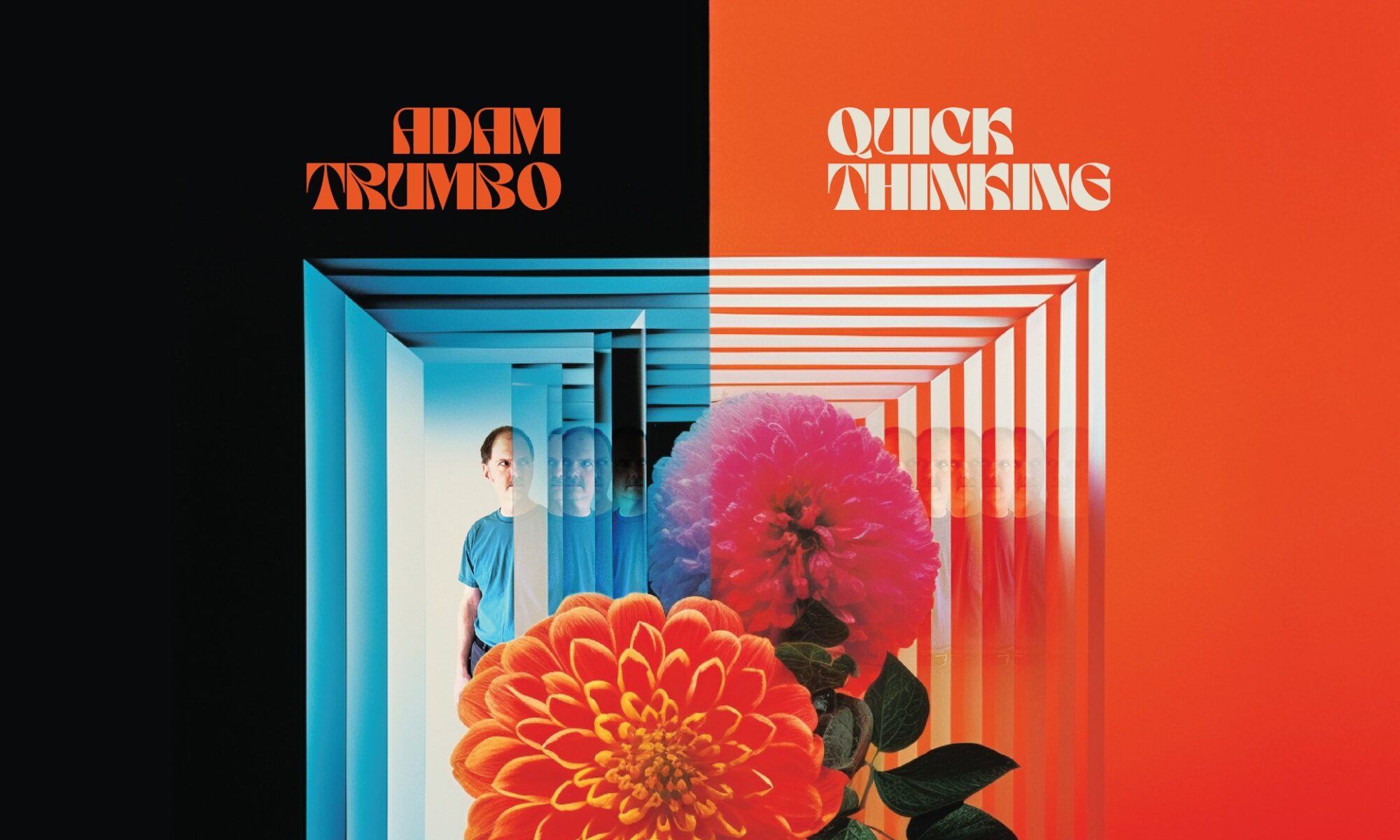
Quick Thinking
Adam Trumbo | 2025 | FST251
—
Unknown Lexington KY guitarist makes his fifth record about AI anxiety and perceptual unreliability using guitars that sound like synthesizers, which is either a gimmick or a thesis depending on your patience for concept albums from people you’ve never heard of. It’s a thesis. “Predictions” channels Emily Dickinson processing an algorithmic world, which sounds preposterous and isn’t, and “Call Your Bluff” ends with Jenny’s phone number after five minutes of genuine emotional weight, which sounds like a punchline and is also the wisest move on the record. Trumbo writes conversational lyrics that somehow carry real weight, avoids cynicism without being naive about it, and keeps the whole thing to 32 minutes because he respects your time. Worth finding. B+
Adam Trumbo is a name you likely don’t know, and Quick Thinking — his fifth solo album — is the kind of record that makes that anonymity feel genuinely puzzling. The Lexington, Kentucky guitarist has constructed something quietly remarkable here: an album about AI and distorted reality that creates synthesizer sounds exclusively through guitars, proving its thesis about perceptual unreliability before the first song ends. The conceit would be merely clever if the songs underneath weren’t so good. Think Kurt Vile collaborating with the Pixies, with Tom Petty editing the tracklist down to its essential 32 minutes. “Predictions” and “Call Your Bluff” — which ends, gloriously, with Jenny’s phone number — are as good as anything you’ll hear this year from anyone operating this far outside the mainstream. Seek it out.
You probably haven’t heard of Adam Trumbo, and that’s the kind of thing that becomes harder to justify the longer you sit with Quick Thinking, his fifth solo record. The Lexington, KY guitarist has made a new wave-adjacent album about AI, mental overload, and the slow erosion of shared reality — except there are no synthesizers anywhere on it, just guitars, bass, and drums conjuring textures that shouldn’t be possible without keyboards. It’s a conceptual trick that actually works, and works in service of something genuinely felt rather than merely clever. At 32 minutes across 10 songs, Quick Thinking moves like a record that knows exactly what it is — somewhere between Kurt Vile’s hazy drift, the Pixies’ dynamic tension, and Tom Petty’s instinct for what stays and what goes. Mastered by Jack Endino. Worth your time.
I’ll tell you exactly when I knew this record was the real thing. It was two in the morning and I’d been sitting in my apartment for three hours listening to “Predictions” on repeat — this guy from Lexington, Kentucky, nobody you’ve heard of, Adam Trumbo, making guitars sound like synthesizers and synthesizers sound like the end of the world — and somewhere around the fourth listen I realized I’d stopped thinking about the record and started thinking about my own life, which is either the highest compliment I know how to give a piece of music or a sign that I need to get out more. Probably both.
Here’s what nobody tells you about the anxiety of living in 2025: it’s not dramatic. It doesn’t announce itself. It just sits there in the palm of your hand, which is also what Trumbo’s second track is literally about, this guy scrolling and scrolling and finally deciding to go for a walk instead, and I thought, yeah, man, me too, except I’m still here at two in the morning listening to your record, so maybe neither of us is doing great, but at least we’re doing it together.
The Velvet Underground understood that rock and roll was about the sound of reality coming apart at the seams while you danced. The Pixies understood that you could make beauty out of pure sonic violence. Tom Petty understood that a great song should feel like it always existed. Trumbo somehow understands all three of these things simultaneously and packages them into 32 minutes with no synthesizers — none, he swears, and I believe him, partly because I can’t prove otherwise and partly because the whole point of the record is that you can’t trust your own perception anyway, which is either a great joke or a terrifying statement about the current moment or both.
“Call Your Bluff” ends with Jenny’s phone number. 867-5309. I laughed out loud at two in the morning alone in my apartment, which felt like exactly the right response to exactly the right record. Get this thing. Get it now. A
There is a moment in “Cascading Images,” the eighth track on Adam Trumbo’s Quick Thinking, when the chord progression does exactly what the title promises — falls, cascades, one chord pulling the next downward like water finding its level — and in that moment something ancient and something completely contemporary occupy the same space simultaneously. This is not a trick. It is the record’s central achievement, and it is the achievement of American vernacular music at its most self-aware: the understanding that form and content are not separate concerns.
Trumbo is working in a tradition that runs from the Carter Family through Chuck Berry through the Velvet Underground through the Pixies — the tradition of musicians who understood that how you play is inseparable from what you mean. His decision to create an album that sounds like synthesizers while using only guitars is not merely conceptual cleverness. It is a statement about the nature of American reality in the age of artificial intelligence: that what we perceive and what is real have always been negotiable, and that the negotiation has always happened through culture, through music, through the stories a society tells itself about what it hears.
“Predictions” channels, Trumbo has said, Emily Dickinson reacting to an AI world. This is not as strange as it sounds. Dickinson spent her career compressing enormous and unanswerable questions into small, slant-rhymed vessels — consciousness, death, eternity, the nature of perception itself. Trumbo does the same thing with a guitar and a Mel9 pedal and a Mono Synth pedal and the accumulated weight of the present moment. “Once again, all the stars are aligned, theoretical signs, with the patterns removed.” The patterns removed. We impose meaning. We always have. Technology simply gives us better tools for the imposition.
The album ends with Jenny’s phone number. In 1981, Tommy Tutone wrote a song about a number on a bathroom wall — anonymous desire, the confusion of public and private, a girl who may or may not exist transformed into a shared cultural hallucination. That Trumbo invokes her at the conclusion of an album about AI and the blurring of reality is not a joke. It is the oldest American move: finding the profound in the disposable, the eternal in the ephemeral, the ghost in the machine wearing a smile.
Adam Trumbo is the kind of artist that the music industry was specifically designed to ignore, which is to say he is precisely the kind of artist worth paying attention to. Quick Thinking, his fifth solo record, arrives from Lexington, Kentucky with the quiet confidence of someone who has long since stopped waiting for permission — thirty-two minutes of guitars masquerading as synthesizers, new wave atmosphere conjured from pure string and wood and the accumulated wisdom of someone who has been listening very carefully for a very long time.
The reference points are impeccable and worn lightly: the twitchy urgency of the late-period Saints, the melodic generosity of early Tom Petty, the hazy introspection of Kurt Vile, the harmonic strangeness of Cate Le Bon, and underneath all of it, the dynamic tension of the Pixies, whose influence on the record’s final mix Trumbo himself acknowledges with characteristic candor. These are not influences in the sense of imitation. They are the water in which a serious musician has been swimming for decades, and Quick Thinking moves through them with the ease of someone entirely at home in deep water.
The album’s themes — mental health, technological anxiety, the fragmentation of shared reality — are handled with a restraint that is itself a kind of argument. Trumbo has said that cynicism has its place but can be oppressive, that there is already too much of it taking up collective head space. Quick Thinking is the sound of an artist actively refusing that oppression, finding encouragement and dark humor and genuine human warmth in the same moments where other songwriters would reach for despair. “Call Your Bluff” closes the record at five minutes and thirty-nine seconds — long by the album’s compressed standards — building slowly, releasing fully, and ending with Jenny’s phone number, which is simultaneously a joke and a gift and a small act of grace.
Jack Endino’s mastering is characteristically alive. Jason Groves’s mix is, by Trumbo’s own account, excellent and unexpected. The record sounds like something that matters. In 2025, that is not nothing.
The question Quick Thinking keeps asking — quietly, persistently, without the self-congratulation that usually accompanies concept albums — is whether we have consented to what is happening to us. Not in the legal sense, not in the terms-and-conditions sense, but in the deeper sense of genuine human agency: do we know what we have agreed to, and do we want it?
Adam Trumbo, a Lexington, Kentucky guitarist making his fifth solo record in productive obscurity, frames this question through the specific textures of daily life — scrolling before you’re out of bed, notifications arriving before consciousness has fully assembled itself, the palm of the hand as the site of both connection and invasion. He is not the first artist to address these themes, but he addresses them with an honesty and a formal intelligence that sets Quick Thinking apart from the more obvious responses to technological anxiety.
The album’s central formal conceit — guitars only, no synthesizers, new wave atmosphere achieved entirely through pedal work and technique — is not merely clever. It enacts the album’s argument about perception and reality in the most direct way possible: by making you hear something that isn’t there, Trumbo demonstrates that your perceptual apparatus is already compromised, already susceptible to the kind of manipulation that the album is warning against. This is not a trick played on the listener. It is an act of solidarity — we are all, Trumbo suggests, working with unreliable equipment.
What distinguishes Trumbo from the merely anxious is his refusal of cynicism as a destination. The album’s characters go for walks. They make room for the bloom. They call bluffs and lean into their songs. They assert, repeatedly and with genuine conviction, that there is more than one way to be. This is not naivety. It is the harder position — the one that requires more courage and more craft than despair, which is always easier to write and always easier to sell.
“More Than One Way” is the album’s most explicitly resistant track, and its resistance is collective rather than individual — “we know when something’s up,” Trumbo sings, “we’re sick and tired of them pushing us around.” The “them” is productively unspecified. The “we” is the point. In a cultural moment that atomizes experience and monetizes loneliness, the assertion of a “we” is itself a political act.
The album ends with Jenny’s phone number. It is the right ending — funny and warm and slightly surreal, a reminder that shared cultural memory is itself a form of resistance, that the things we hold in common cannot be easily algorithmically optimized. Trumbo is an artist worth finding. The fact that you probably haven’t heard of him is the music industry’s failure, not his.
—
Adam Trumbo’s Quick Thinking is available on CD and all major streaming platforms including Spotify, Apple Music, and Amazon Music.